Whether you are a seasoned competitor or a passionate club player, an inclusive and high-energy atmosphere awaits you. Our tournament offers categories for all skill levels, ensuring a fair and competitive experience for everyone.
Whether you're aiming for the podium or playing for the love of the game, we can’t wait to see your talent in action.
Categories
- FLINTA - a dedicated category for women, lesbians, intersex, non-binary, trans and agender participants.
- Open - any athlete is welcome to compete, regardless of gender identity. Available for Singles and Doubles.
- Mixed Doubles - Teams must consist of one FLINTA player and one Open player.
Skill levels
Participants are asked to self-select a skill rating based on their competitive experience and technical ability. These guidelines are designed to help you accurately place yourself for seeding purposes; they are not rigid rules but an exercise in good faith to promote balanced draws.
C- (Recreational/Novice)
New to competitive play. Rarely plays external tournaments. Focus is primarily on exercise and learning the rules.
C+ (Developing)
Regular club play or social games (1-2 times per week). Occasional participation in friendly/local club tournaments.
B- (Intermediate Club)
Active in club leagues or internal competitive ladders. May have played a few non-ranking tournaments. Understands basic court positioning.
B+ (High Intermediate/Upper Club)
Competes regularly in local or regional leagues. Consistent results against similarly graded players. Starting to incorporate strategic variation.
A- (Advanced/Regional)
Competes successfully in regional or national non-ranking tournaments. Training focuses heavily on tactical plays and specialized shot execution.
A+ (Elite Advanced)
High-level regional or lower-national ranking experience. Consistent finalist/winner in competitive open tournaments. Training is structured and highly intensive.
The FLINTA singles/doubles and mixed doubles competitions have level A (combining A+ and A-).
We operate this skill classification system based on trust and good faith. We encourage all players to be honest about their current level of play, as accurate self-seeding is the key to ensuring all matches are balanced, exciting, and competitive for everyone involved. The Tournament Committee reserves the right to review seeding only in cases of clear and deliberate misclassification that undermines the integrity of the tournament.
Promotion of previous tournament players
For smaller tournaments, we ask that you move up a category if you have won 3 medals previously.
For doubles higher player category takes precedence e.g. B- and C+ would play at B-.
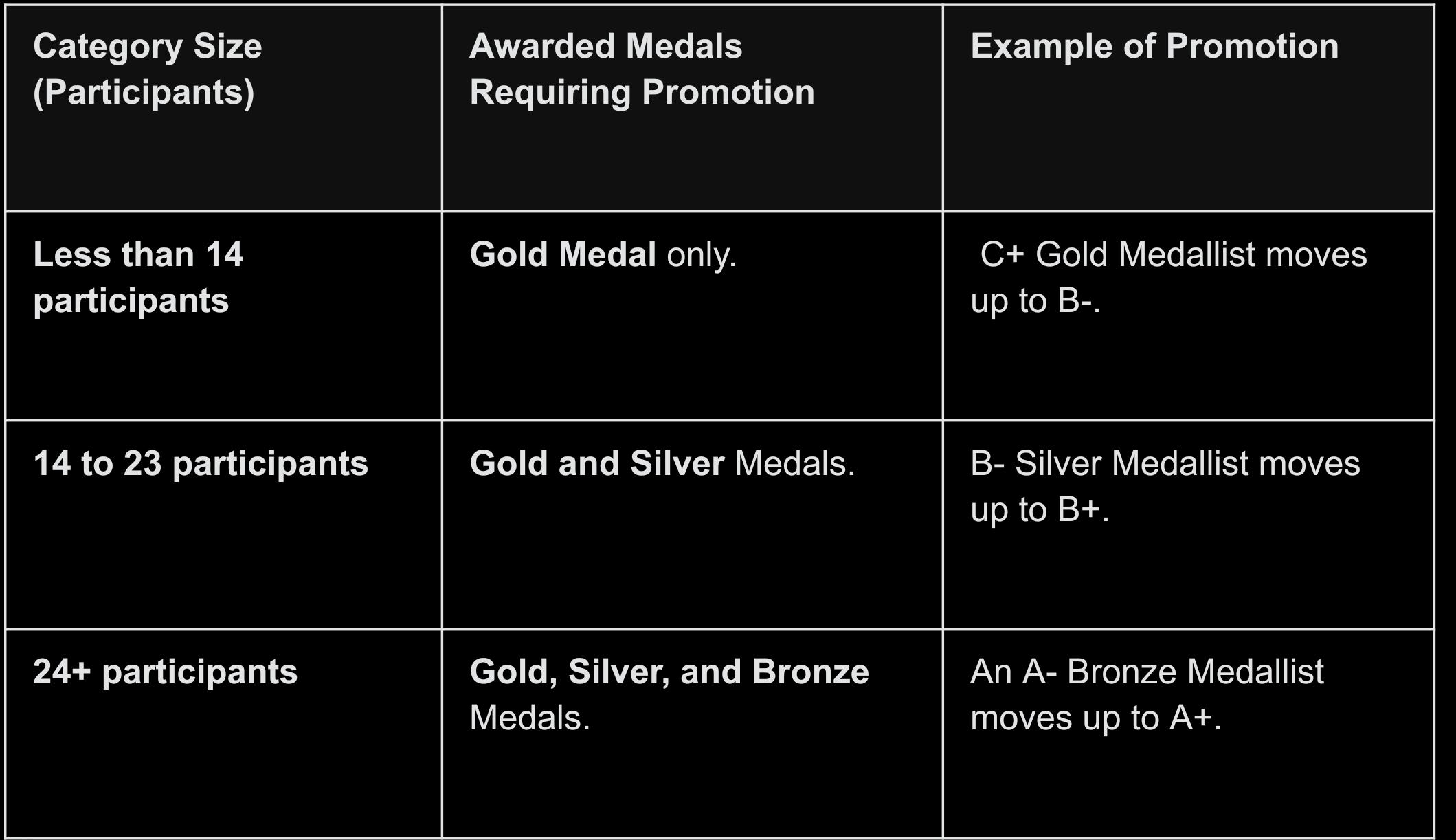
The number of participants in a category determines how many medal positions are considered strong enough to trigger an automatic promotion. This ensures that promotions remain meaningful and proportionate to the level of competition.
- Smaller categories (fewer than 14 participants) only award promotion eligibility to the Gold Medallist, as there are fewer competitors overall.
- Medium-sized categories (14–23 participants) recognise both Gold and Silver Medallists for promotion.
- Large categories (24+ participants) allow Gold, Silver, and Bronze Medallists to qualify for promotion due to the increased depth and competitiveness of the field.
For example, in a very large tournament of 200+ participants, a bronze medal in a category containing 24+ participants, would result in a promotion of category
Accessibility
The competition is inclusive (with some adjustments available) for participants with physical impairments, including those who may use a wheelchair. Unfortunately we are not able to cater for those with a visual impairment.
Other information
- The competitions follow official Badminton World Federation (BWF) rules. Matches are played as the best of three games to 15 points, using the rally point system.
- Tournament-grade feather shuttlecocks will be provided for all matches.
- You are able to enter one singles and two doubles events should you wish to as they are at different times.